Chapter 3: Sleep Cycles within a Night
Now you understand how your sleep rhythm gives a regular schedule of sleep from night to night. Next, we’ll look into how, within a single night of sleep, your brain cycles between different types of phases of sleep. This is important to understanding the function of sleep for your brain.
In summary, your brain switches between two types of sleep - REM (rapid eye movement) and non-REM (NREM) sleep. The two types of sleep have different functions - simplistically:
- NREM clears out old memories and mental “trash,” and it moves information into long-term storage.
- REM strengthens the valuable connections that remain, and it forges creative novel connections.
In total for a single night, there’s about an 80/20 split between NREM/REM sleep.
When you sleep, your brain goes through sleep cycles that each last about 90 minutes. Each sleep cycle generally begins with NREM sleep, then ends with REM sleep. As one cycle ends, the next begins. You can see this in a sleep graph here:
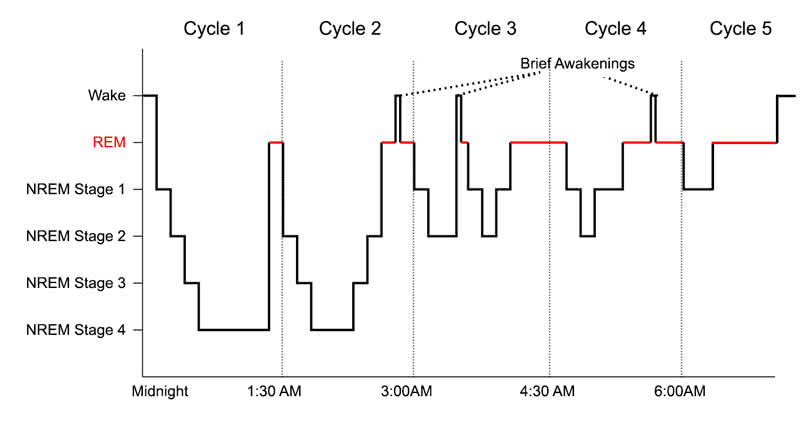
A deeper line means going deeper into NREM sleep.
How Sleep Cycles Change Through the Night
Notice that not all sleep cycles look the same. As the sleep progresses through the night, a greater fraction of each cycle is spent in REM sleep.
Why would the sleep cycles be unbalanced in this way? Why not just have all sleep cycles look the same, with 80% in NREM and 20% in REM?
The author hypothesizes that it’s like making a sculpture out of a mass of clay. Earlier in the night, more NREM is needed to clear out junk memories that aren’t useful anymore. Then once only the useful stuff remains, REM strengthens what’s left.
(Shortform note: One way to think about this is that an animal might be interrupted in the middle of the night. So if an animal could only sleep 3 hours in one night, it’d make sense for the more critical functions to be performed first, with the later functions being a luxury if the animal could sleep a full night. This may suggest that NREM performs a more vital function for survival.)
Also, beware of what this means for cutting your sleep short. If you normally sleep 8 hours, and one night you have to cut sleep to 6 hours, then you’re not just losing 25% of sleep - you might be losing 60-90% of your REM sleep!
Likewise, going to sleep later than usual might cut short your NREM sleep.
What REM and NREM Look Like
REM and NREM are distinguishable by measuring electrical activity in the brain. NREM is characterized by slow (3-4 Hz) waves that propagate far from the frontal cortex to the back of the brain. REM is characterized by faster (30-40 Hz), frenetic activity that looks the same as being awake.
Wakeful thought looks frenetic because many different neural signals are occurring at once throughout the brain. An analogy: it’s like a microphone picking up a football stadium full of distinct conversations. The summation of all the conversations just looks like noise.
In contrast, NREM sleep is a slow, pulsing wave that’s noticeably different from REM sleep. Continuing the analogy, it’s like a stadium full of voices singing in synchronization. That billions of neurons can do this together is awe-inspiring.
What’s the function of these slow NREM waves? By being lower frequency, slow NREM waves can propagate further without attenuation, like AM radio waves. The author suggests this is useful in transferring memories far across the brain, from temporary memory stores toward more permanent storage. It also allows communication across the brain for different sections to collaborate on their shared experience.
REM sleep looks like awake activity, and it’s where dreams happen. A few odd things happen during REM sleep:
- Your sense of time in dreams seems dilated - an hour may seem to pass when in reality only 5 minutes have.
- Unlike the rest of sleep, you consciously perceive your senses, like sight and sound. In non-REM sleep, the thalamus in your brain blocks you from consciously perceiving senses. Once REM sleep starts, this blockade is released.
- In REM sleep, your eyes move rapidly This was initially thought to be visual exploration of the dream field, but this turns out to be more related to the creation of REM sleep than passive observation of it.
If REM sleep looks like wakefulness, how can an observer distinguish someone who’s dreaming from being awake? Muscle atonia - during REM sleep, your voluntary muscles are completely limp. Your brain does this to prevent you from acting out your dreams, since fighting an enemy might cause you to accidentally punch your surroundings.
One last detail: sleep spindles (bursts of activity) occur at the end of slow waves, possibly serving a function to block external sensory input from disrupting sleep. People with more sleep spindles are heavier sleepers.