Chapter 2: Your Daily Sleep Rhythm
(Chapter 1 is just an introduction, so we’re skipping it.)
Sleep is universal in animals, even in insects and worms, despite its apparent drawbacks (vulnerability to predators, loss of time for productivity). When a biological feature is preserved deep in evolutionary history, it is usually a critical function. This must mean sleep is a critical function, and it’s important to understand why it’s important.
How Sleep Rhythm Works
Sleep is regulated by two mechanisms:
- The circadian rhythm, regulated by melatonin (produced by the suprachiasmatic nucleus in the brain). Think of this as a natural “wake drive,” making you stay awake during the day and waning during night.
- The circadian rhythm responds to light and darkness to calibrate itself. It’s naturally 24 hours and 15 minutes long on average.
- Adenosine is a fatigue signal and causes “sleep pressure.” This rises consistently through the day without sleep, making you feel more tired. Sleeping depletes adenosine, and you wake up with a lower level.
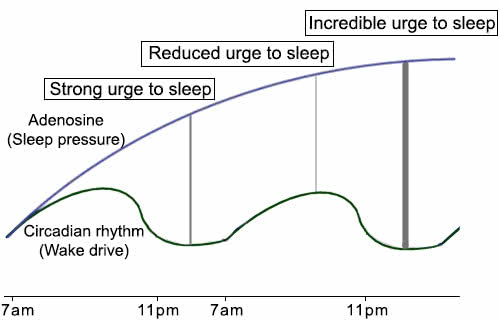
These two mechanisms interact as shown in this graph:

Notice that sleep naturally happens when the difference between curves is greatest - you feel the greatest sleep pressure from adenosine, and the least “wake drive” from your circadian rhythm.
This explains an odd phenomenon: if you’ve ever had to pull an all-nighter, you might have noticed yourself getting a second wind in the morning, oddly feeling more awake at 8AM than at 3AM. This happens because the circadian rhythm “wake drive” is starting up again, and reduces the adenosine-circadian gap.
Circadian rhythms vary from person to person, depending on when they naturally wake up and have maximum energy. The idea of “morning people” and “night owls” is real.
- Whether you’re a morning or night person strongly depends on your genetics.
- Why would humans evolve with this variation? Evolutionarily, having a mixture of morning people and night owls allows a population to reduce its vulnerability in nighttime to a shorter period of time.
- Example: As morning people sleep earlier (say at 10PM), night owls can keep up the watch. Then as night owls get tired (say around 4AM), the morning people are starting to wake.
- But in modern times, the night owls are heavily punished, since early work times force night owls to sleep and wake up earlier than they would naturally prefer. This reduces performance in the mornings. Furthermore, by the time night owls peak in the afternoon, the workday has already ended.
How You Disrupt Your Sleep Rhythm
Now that you understand how sleep rhythm works, you can better understand common disruptions to sleep.
Caffeine blocks adenosine receptors, thus reducing how much you feel the “sleep pressure.” If you ever drink coffee and then feel a crash later, this comes from caffeine wearing off while adenosine keeps increasing throughout the day.
- Caffeine has a half-life of 5-7 hours, depending on genetics for the cytochrome P450 enzyme in your liver. Some people metabolize caffeine more quickly than others.
- Be careful when drinking decaf, as it apparently contains 15-30% of the caffeine in regular coffee - it’s nowhere near zero caffeine.
Jetlag disrupts your circadian rhythm.
- Jetlag is usually worse when you fly eastbound because adjusting your schedule requires falling asleep when the body wants to be awake. This is more difficult than staying awake when your body wants to sleep.
- Since the circadian rhythm is slightly longer than a day, lengthening it is easier than shortening it.
How do you know if you have a sleep deficit? Here are a few signs:
- You don’t wake up naturally at the time you set your alarm - this means your body wants more sleep.
- When you read, you often lose track and need to read a sentence twice.
- You feel drowsy just a few hours after waking.
- You need coffee to feel functional.
Luckily, later in this book, we’ll discuss how to improve your sleeping habits and reduce your sleep deficit.