Lesson 1: The Rich Don’t Work For Money - Money Works for Them
With the narrative over, the rest of the book covers Robert Kiyosaki’s major lessons from Rich Dad.
Most people work 40+ hours a week to earn salaries. Many then take their earnings to 1) buy stuff they think will make them happy (but this is short-lived), 2) save the remainder in a conservative way.
While this ensures some degree of stability, it doesn’t make you rich. And working to earn a pension makes you financially dependent - let alone the risk that pensions won’t be funded decades from now, when you need it.
The counter-intuitive lesson here is this: the rich don’t get rich merely by being paid higher salaries (though this is a great help). They get rich so by owning things. No one on the Forbes billionaire list got there purely with a salary.
(As tech investor Sam Altman says, “You get truly rich by owning things that increase rapidly in value. This can be a piece of a business, real estate, natural resource, intellectual property, or other similar things. But somehow or other, you need to own equity in something, instead of just selling your time. Time only scales linearly.”)
When you work for an employer, you get paid only a fraction of the value that you generate for the employer (otherwise, if the business would go bankrupt). Say your salary is $50k a year. Your work may allow your employer to earn $100k in sales that year, yielding a clean profit after deducting your salary.
- Even further, if your work isn’t just a pure service but also builds value in the company - say in R&D or product improvement - the value may be many multiples of your salary.
The key to financial independence is having money that makes more money. You want your money to make enough money that you don’t have to work anymore.
Cashflow Diagrams
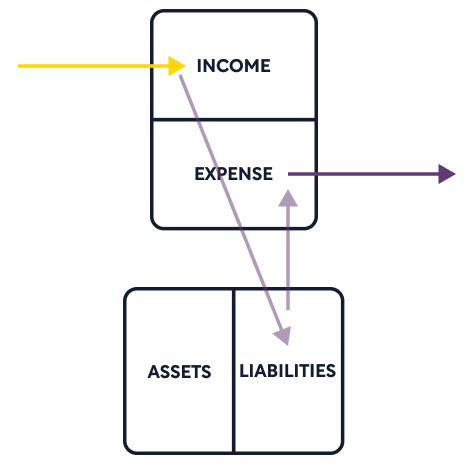
To picture this, here’s a simple financial diagram from Rich Dad, Poor Dad on how cashflow and balance sheet relate to each other:

The top box is an income statement, measuring how much income you get in a period, and how much expenses you pay out.
The bottom diagram is the balance sheet. It shows how much in assets and liabilities you have. Assets are things that make money over time. Liabilities are something that spend money over time. (Shortform note: these are Robert Kiyosaki’s terms and don’t follow typical GAAP accounting.)
We’ll get more into distinguishing assets vs liabilities in the next section, but the main point here is that wealthy people use their Income to buy Assets that return more Income. Meanwhile, they minimize their spending on Expenses and buying Liabilities, to have more money to buy more Assets. Here’s what that looks like:

People who don’t become rich either spend all their income on expenses, or buy liabilities that increase their expenses but don’t add income.
Consider that “money earning money” is your business. Your profession is how you draw a salary. Your business is how, independent of you, your money makes more money.
- Rich Dad, Poor Dad uses McDonald’s as a surprising example. McDonald’s isn’t a hamburger business - it’s in the real estate business. The profession is selling hamburger franchises, but the business is accumulating income-producing real estate.
Achieving Financial Independence
You might have the goal of financial independence, which is to no longer be dependent on your wages. Ideally, you can live forever off of the extra income your money generates - you make more money doing nothing than you consume.
The basic steps for financial independence are:
- Figure out how much money you need per year to survive.
- Figure out how much in assets you need, to generate a return that exceeds the first number (after taxes and expenses).
- Acquire assets that return that amount.
Even if your goal isn’t financial independence, these are still good principles of how to get the best return for your money.
So it’s that simple. But simple doesn’t mean easy. The major blocks are:
- psychological, where people fear the risk of higher-returning assets
- tactical, where people don’t know how to execute well
The rest of this Rich Dad, Poor Dad summary covers both obstacles.